Showing posts with label BIO. Show all posts

Remembering Pearl Harbor


67 years ago today (I originally posted this on December 7, 2008) the Japanese unleashed a vicious surprise air assault on the U.S. Pacific Fleet at Pearl Harbor, destroying nine ships and severely damaging 21 others. The torpedo and bomb attacks killed almost 2,400 sailors, Marines and soldiers. In memory of the folks who perished that day I am posting a few excerpts from an article in the Tulsa World newspaper:

Robert Norman (pictured right) knew it would happen, long before it finally did.

In 1937, he was a young sailor aboard the battleship USS Nevada, and he and his crewmates often watched freighters, laden with scrap metal, leave California ports westward across the Pacific.

Much of that metal went to Japan to feed its hungry war machine, "and we all knew those guns would be coming back at us eventually," Norman recalled.

Four years later, they did.
...
Norman was aboard the Nevada as a boatswain's mate, overseeing a crew of 120 in charge of the rear gun turret and the ship's crane.

He said the Nevada had steamed into Pearl Harbor on Dec. 5. The next day, he and his crew spent the day replacing old gun shells.

It was exhausting work. When they were finished at 11 p.m., all Norman thought about was a good night's rest.

At about 7:55 a.m. the next day, Norman was on his bunk, reading the newspaper, while the ship's band was above on the aft deck, getting ready to play for the morning's flag-raising.

All of a sudden, the band members came screaming down the stairs followed by an urgent voice over the public-address system: "All hands to your battle stations."

Norman had no idea what was going on, even as he dashed up the stairs. Then he saw the Japanese planes swarming in, "the red ball" on their wings.

He doesn't remember his exact feelings. But he recalls everyone jumping to their stations to defend the ship as they had been trained.

The Nevada, which was moored by itself, took a torpedo to the left front of the ship, filling up with water. The Japanese planes continued bombing.

It was the only battleship that day to try to leave the harbor. But Japanese bombers spotted it and tried to sink it to block the harbor entrance. About 17 bombs hit the ship, killing 60 sailors and injuring more than 260.

During the attack, with flames rising, Norman climbed a mast to help Ensign Joseph Taussig Jr. of Newport, R.I., who had been stranded with a severed leg. Norman saved Taussig's life and earned a Silver Star.
...
Looking back on the Pearl Harbor attack, Norman said the biggest lesson is for the nation to be "eternally vigilant."

He said it's far better to recognize a problem ahead of time and stay ahead of it than to try to catch up.

Norman turns 89 on Monday, Dec. 8.

It was on that date in 1941 when Congress declared war on Japan for its "day of infamy."


Captain Robert James Norman, USN, 94, passed away on August 19, 2013 in Sarasota, Florida.

Forgiveness is only a Prayer Away


At the onset of this week that many call holy I though that I might share about an amazing woman of faith. The first time I saw Corrie ten Boom was in 1976 on the game show "To Tell the Truth". I remember how the host, Gary Moore, was awestruck by one of the answers to his questions. Corrie passed away in 1983. Following are a few facts about Corrie that I have gleaned from a PBS site.
Corrie was a survivor of Ravensbruck, a Nazi concentration camp. She was arrested by the Nazis along with the rest of her family for hiding Jews in their Haarlem (Holland) home during the Holocaust. She was imprisoned and eventually sent to the Ravensbruck concentration camp along with her beloved sister, Betsie, who perished there just days before Corrie's own release on December 31, 1944. Inspired by Betsie's example of selfless love and forgiveness amid extreme cruelty and persecution, Corrie established a post-war home for other camp survivors trying to recover from the horrors they had escaped. She went on to travel widely as a missionary, preaching God's forgiveness and the need for reconciliation.
Corrie's message of forgiveness was tested when, by chance, she came face to face with one of her former tormentors in 1947. The following description of that experience is excerpted from her 1971 autobiography, The Hiding Place.
It was in a church in Munich that I saw him, a balding heavy-set man in a gray overcoat, a brown felt hat clutched between his hands. People were filing out of the basement room where I had just spoken. It was 1947 and I had come from Holland to defeated Germany with the message that God forgives. ...

And that's when I saw him, working his way forward against the others. One moment I saw the overcoat and the brown hat; the next, a blue uniform and a visored cap with its skull and crossbones. It came back with a rush: the huge room with its harsh overhead lights, the pathetic pile of dresses and shoes in the center of the floor, the shame of walking naked past this man. I could see my sister's frail form ahead of me, ribs sharp beneath the parchment skin. Betsie, how thin you were!

Betsie and I had been arrested for concealing Jews in our home during the Nazi occupation of Holland; this man had been a guard at Ravensbruck concentration camp where we were sent. ...

"You mentioned Ravensbruck in your talk," he was saying. "I was a guard in there." No, he did not remember me. "I had to do it — I knew that. The message that God forgives has a prior condition: that we forgive those who have injured us." "But since that time," he went on, "I have become a Christian. I know that God has forgiven me for the cruel things I did there, but I would like to hear it from your lips as well. Fraulein, ..." his hand came out, ... "will you forgive me?"

And I stood there — I whose sins had every day to be forgiven — and could not. Betsie had died in that place — could he erase her slow terrible death simply for the asking?

It could not have been many seconds that he stood there, hand held out, but to me it seemed hours as I wrestled with the most difficult thing I had ever had to do.

For I had to do it — I knew that. The message that God forgives has a prior condition: that we forgive those who have injured us. "If you do not forgive men their trespasses," Jesus says, "neither will your Father in heaven forgive your trespasses." ...

And still I stood there with the coldness clutching my heart. But forgiveness is not an emotion — I knew that too. Forgiveness is an act of the will, and the will can function regardless of the temperature of the heart. "Jesus, help me!" I prayed silently. "I can lift my hand, I can do that much. You supply the feeling."

And so woodenly, mechanically, I thrust my hand into the one stretched out to me. And as I did, an incredible thing took place. The current started in my shoulder, raced down my arm, sprang into our joined hands. And then this healing warmth seemed to flood my whole being, bringing tears to my eyes.

"I forgive you, brother!" I cried. "With all my heart!"

For a long moment we grasped each other's hands, the former guard and the former prisoner. I had never known God's love so intensely as I did then.
I saw the movie version of "The Hiding Place" when it was first released to movie theaters over thirty years ago. I rewatched the DVD version a few years ago with my wife and some friends. Corrie's story always reminds me how forgiveness is only a prayer away. When confronted Corrie asked for help to forgive and God was faithful to answer her prayer. I highly recommend "The Hiding Place". I also recommend to you Corrie's example and encourage you to ask God to help you forgive those who have hurt you. It will be good for your soul.


The Rocket Man


Growing up in the 1950s and 60s I was fascinated by America's space program. One name that seemed to regularly surface was Wernher von Braun. Here is an excerpt from Wikipedia:
Wernher Magnus Maximilian, Freiherr von Braun (March 23, 1912 – June 16, 1977) was a German rocket engineer and space architect. He was one of the leading figures in the development of rocket technology in Germany during World War II and, subsequently, in the United States. He is credited as being the "Father of Rocket Science". ... According to one NASA source, he is "without doubt, the greatest rocket scientist in history". His crowning achievement was to lead the development of the Saturn V booster rocket that helped land the first men on the Moon in July 1969. In 1975 he received the National Medal of Science.
I love how a man who worked against us in World War II came to America and helped us go to the moon. I worked on missiles when I was in the Army and was so impressed with the folks who imagined, designed and built them. Sad that NASA's budget has been cut so much. Maybe the moon is the limit? Or maybe we will dream of Space again?


Rosa Parks

55 years ago today a 42 year old African American woman was arrested in Montgomery, Alabama when she refused to obey a bus driver's order that she give up her seat to make room for a white passenger. It is an event that I can hardly get my head around. It is an event that makes me sad. According to the wiki:
Parks' act of defiance became an important symbol of the modern Civil Rights Movement and Parks became an international icon of resistance to racial segregation. She organized and collaborated with civil rights leaders, including boycott leader Martin Luther King, Jr., helping to launch him to national prominence in the civil rights movement.
I thank God for the courage of this amazing woman and honor her today as I remember these things that she once said.. some of which are difficult to read.

Each person must live their life as a model for others.

The only tired I was, was tired of giving in.

I'm tired of being treated like a second-class citizen.

All I was doing was trying to get home from work.

It was not pre-arranged. It just happened that the driver made a demand and I just didn't feel like obeying his demand. I was quite tired after spending a full day working.

He pointed at me and said, 'that one won't stand up.' The two policemen came near me and only one spoke to me. He asked me if the driver had asked me to stand up? I said, 'yes.' He asked me why I didn't stand up, ... I told him I didn't think I should have to stand up. So I asked him: 'Why do you push us around?' And he told me, 'I don't know, but the law is the law and you are under arrest.

At the time I was arrested I had no idea it would turn into this. It was just a day like any other day. The only thing that made it significant was that the masses of the people joined in.

I have learned over the years that when one's mind is made up, this diminishes fear; knowing what must be done does away with fear.

I would like to be remembered as a person who wanted to be free... so other people would be also free.

George Washington Carver

My friend Jeff recently posted George Washington Carver's virtues on Facebook. Got me to browsing around on Wikipedia. Following are a few wiki clips.
Dr. Carver viewed faith in Jesus as a means of destroying both barriers of racial disharmony and social stratification. He was as concerned with his students' character development as he was with their intellectual development. He even compiled a list of eight cardinal virtues for his students to emulate and strive toward:
  1. Be clean both inside and outside.
  2. Neither look up to the rich nor down on the poor.
  3. Lose, if need be, without squealing.
  4. Win without bragging.
  5. Always be considerate of women, children and old people.
  6. Be too brave to lie.
  7. Be too generous to cheat.
  8. Take your share of the world and let others take theirs.
Unconventional in respect to both his scientific method and his ambition as a teacher, he inspired as much criticism as he did praise. Dr. Carver expressed this sentiment in response to this phenomenon: "When you do the common things in life in an uncommon way, you will command the attention of the world."
I especially liked the thought provoking way that Carver expressed his virtues. They embody a morality that I can relate to. Numbers 6 and 7 especially speak to me. And I love the quote.

Dag Hammarskjöld

This week Sue shared a prayer from Dag Hammarskjöld at the Daily Prayer blog. It brought back memories of Junior High social studies.. seems like I had to remember his name for a test. Here are a few facts from the Wiki on Dag:
Dag Hjalmar Agne Carl Hammarskjöld (1905-1961) was a Swedish diplomat, economist and author and was the second Secretary-General of the United Nations. He served from April 1953 until his death in a plane crash in September 1961. He is the only person to have been awarded the Nobel Peace Prize posthumously. Hammarskjöld remains the only U.N. Secretary-General to die in office. U.S. President John F. Kennedy called Hammarskjöld “the greatest statesman of our century.”
Here are a few things that he once said:

Do not seek death. Death will find you. But seek the road which makes death a fulfillment.

Never for the sake of peace and quiet deny your convictions.

Forgiveness is the answer to the child's dream of a miracle by which what is broken is made whole again, what is soiled is made clean again.

It is when we all play safe that we create a world of utmost insecurity.

"Freedom from fear" could be said to sum up the whole philosophy of human rights.

Is life so wretched? Isn't it rather your hands which are too small, your vision which is muddled? You are the one who must grow up.

Friendship needs no words - it is solitude delivered from the anguish of loneliness.

God does not die on the day when we cease to believe in a personal deity, but we die on the day when our lives cease to be illumined by the steady radiance, renewed daily, of a wonder, the source of which is beyond all reason.

In the last analysis, it is our conception of death which decides our answers to all the questions that life puts to us.

Joni Eareckson Tada

Joni is one of the most amazing people that I have never met. Her endurance and overcoming attitude often leaves me filled with awe. Here is the wiki on Joni:

A diving accident in 1967 left Tada hospitalized and paralyzed (as a quadriplegic; unable to use her hands or legs). After two years of rehabilitation and in a wheelchair, Tada began working to help others in similar situations. Tada wrote of her experiences in her international best-selling autobiography, Joni, which has been distributed in many languages, and which was made into a feature film of the same name.

During her two years of rehabilitation, Joni learned how to paint with a brush between her teeth, and has sold a lot of her artwork. Joni's art is what initially catapulted her into national prominence.. it is amazing what she does holding a brush between her teeth. It is equally amazing the things that come out of her mouth. Here are a few things that Joni has said:

Even though I have rough moments in my wheelchair, for the most part I consider my paralysis a gift. Just as Jesus exchanged the meaning of the Cross from a symbol of torture to one of hope and salvation, He gives me the grace to do the same with my chair. If a cross can become a blessing, so can a wheelchair. The wheelchair, in a sense, is behind me now. The despair is over. There are now other crosses to bear, other "wheelchairs" in my life to be exchanged into gifts.

Sometimes God allows what he hates to accomplish what he loves.

Heartache forces us to embrace God out of desparate, urgent need. God is never closer than when your heart is aching,

Contentment ... has an internal quietness of heart that gladly submits to God in all circumstances.

The fact that disabled people hang in there does something for Christians. It's not about being an inspiration for others, it more than that.... it's a mystery. God somehow strengthens others by their faithfulness. They may feel like a burden to others, but God thinks the opposite. He thinks its necessary for others to take care of the disabled... they do more for one's spiritual well being than can be imagined.

Nelson Mandela


Ann and I watched Invictus last night.. more on that at a later date.. and what impressed me the most was the man that the movie centered on. Here are a few words from the Wiki:
In 1962 Nelson Mandela was arrested and convicted of sabotage and other charges, and sentenced to life in prison. Mandela served 27 years in prison, spending many of these years on Robben Island. Following his release from prison on 11 February 1990, Mandela led his party in the negotiations that led to multi-racial democracy in 1994. As president from 1994 to 1999, he frequently gave priority to reconciliation. In South Africa, Mandela is often known as Madiba, an honorary title adopted by elders of Mandela's clan. Mandela has received more than 250 awards over four decades, including the 1993 Nobel Peace Prize.
To honor him I thought that I would post a few of the things that this great man has said:

If there are dreams about a beautiful South Africa, there are also roads that lead to their goal. Two of these roads could be named Goodness and Forgiveness.

If you want to make peace with your enemy, you have to work with your enemy. Then he becomes your partner.

It is better to lead from behind and to put others in front, especially when you celebrate victory when nice things occur. You take the front line when there is danger. Then people will appreciate your leadership.

I learned that courage was not the absence of fear, but the triumph over it. The brave man is not he who does not feel afraid, but he who conquers that fear.

Education is the most powerful weapon which you can use to change the world.

There can be no keener revelation of a society's soul than the way in which it treats its children.

For to be free is not merely to cast off one's chains, but to live in a way that respects and enhances the freedom of others.

I detest racialism, because I regard it as a barbaric thing, whether it comes from a black man or a white man.

I dream of an Africa which is in peace with itself.

I dream of the realization of the unity of Africa, whereby its leaders combine in their efforts to solve the problems of this continent. I dream of our vast deserts, of our forests, of all our great wildernesses.

There is no passion to be found playing small - in settling for a life that is less than the one you are capable of living.


Saint Edith Stein

According to Wikipedia, Saint Edith Stein (1891-1942) was a German-Jewish philosopher, nun, martyr, and saint of the Roman Catholic Church. Born into an observant Jewish family but an atheist by her teenage years, she converted to Christianity in 1922, was baptized into the Roman Catholic Church and was received into the Discalced Carmelite Order as a postulant in 1934. She was canonized as Saint Teresia Benedicta of the Cross (her monastic name) by Pope John Paul II in 1998; however, she is often referred to as "Saint Edith Stein".

To avoid the growing Nazi threat, her order transferred her to the Carmelite monastery at Echt in the Netherlands in 1939. Even so she was not safe in the Netherlands—the Dutch Bishops' Conference had a public statement read in all the churches of the country on July 20, 1942, condemning Nazi racism. In a retaliatory response on July 26, 1942, the Reichskomissar of the Netherlands, Arthur Seyss-Inquart, ordered the arrest of all Jewish converts, who had previously been spared. Stein and her sister Rosa, also a convert, were captured and shipped to the Auschwitz concentration camp, where they were gassed on August 9, 1942 when Edith was 51. Here are a few things that Saint Edith said:

If anyone comes to me, I want to lead them to Him.

As for what concerns our relations with our fellow men, the anguish in our neighbor's soul must break all precept. All that we do is a means to an end, but love is an end in itself, because God is love.

My longing for truth was a single prayer.

One could say that in case of need, every normal and healthy woman is able to hold a position. And there is no profession which cannot be practiced by a woman.

The nation... doesn't simply need what we have. It needs what we are.

Ettore Boiardi

Many of us who grew up in the pre-microwave era of tin-foil-panned frozen dinners and Jiffy-Pop stove-top popcorn well remember the canned pasta offered by Chef Boy-ar-dee.. but many of us probably did not know that the Chef was a real guy and the image on the can was his true-life picture. Here is a bit of his story with thanks to Wikipedia:

Ettore (Hector) Boiardi was born to Giuseppe and Maria Maffi Boiardi in Piacenza, Italy. On May 9, 1914, at the age of 16, he arrived at Ellis Island aboard the French ship La Lorraine.

Boiardi followed his brother to the kitchen of the Plaza Hotel in New York City, working his way up to head chef. In 1915, he supervised the catering for the reception of President Woodrow Wilson's second wedding at the Greenbrier, in West Virginia. His entrepreneurial skill became fine-tuned when he opened his first restaurant, Il Giardino d'Italia, whose name translated as “The Garden of Italy,” at East 9th Street and Woodland Avenue in Cleveland, Cuyahoga County, Ohio, in 1926. The patrons of Il Giardino d'Italia frequently asked for samples and recipes of his spaghetti sauce, which he often gave to customers in old milk bottles.

Boiardi began to use a factory in 1928 to keep up with orders, setting his sights on selling his product nationally. Touting the low cost of spaghetti products as a good choice to serve to the entire family, Boiardi introduced his product to the public in 1929. In 1938, production was moved to Milton, Pennsylvania, where Boiardi was able to maintain greater quality control over his products. He even grew his own tomatoes and mushrooms in the factory basement for use in his creations. Proud of his Italian heritage, Boiardi sold his products under the brand name “Chef Boy-Ar-Dee” so that his American customers could pronounce his name properly.

Boiardi's company made and prepared millions of rations for American and Allied troops during World War II, and for his efforts he was awarded a gold star order of excellence from the United States War Department. After struggling with cashflow and managing rapid internal growth, he sold his brand to American Home Foods, later International Home Foods, for approximately $6 million. Boiardi then invested in steel mills, which helped produce goods needed for the Korean war.

Alexander Haig, 1924-2010

Former Secretary of State, Alexander Haig, died yesterday. According to Wikipedia:
Haig was a United States Army general who served as the United States Secretary of State under President Ronald Reagan and White House Chief of Staff under Presidents Richard Nixon and Gerald Ford. In 1973 Haig served as Vice Chief of Staff of the Army, the number-two ranking officer in the Army. Haig served as the Supreme Allied Commander Europe, commanding all U.S. and NATO forces in Europe. A veteran of the Korean War and Vietnam War, Haig was a recipient of the Distinguished Service Cross, the Silver Star with oak leaf cluster, and the Purple Heart.
I think that this Haig quote is an indication of why he rose to the highest levels of leadership in our country - both in military and government service.
"Practice rather than preach. Make of your life an affirmation, defined by your ideals, not the negation of others. Dare to the level of your capability then go beyond to a higher level."
I like the focus on doing rather than talking.. on affirming your ideals and going beyond your limitations. My prayers are with his friends and family.

Corrie ten Boom

Cornelia Johanna Arnolda ten Boom, generally known as Corrie ten Boom, (April 15, 1892 – April 15, 1983) was a Dutch Christian Holocaust survivor who helped many Jews escape the Nazis during World War II. Corrie co-wrote her autobiography, The Hiding Place, which was later made into a movie of the same name. In December, 1967, Corrie was honored as one of the Righteous Among the Nations by the State of Israel. I blogged about her and her struggle to forgive a Nazi guard a few years ago. Here are a few quotes fron this precious woman of God:

Worry does not empty tomorrow of its sorrow; it empties today of its strength.

Forgiveness is an act of the will, and the will can function regardless of the temperature of the heart.

Never be afraid to trust an unknown future to a known God.

It is not my ability, but my response to God’s ability, that counts.

Joy runs deeper than despair.

The measure of a life, after all, is not its duration, but its donation.

When a train goes through a tunnel and it gets dark, you don't throw away the ticket and jump off. You sit still and trust the engineer.

Billy Cosby

Growing up in the 60s one of my favorite comedy albums was "Bill Cosby Is a Very Funny Fellow...Right!".. I loved his funny stories.. still remember the conversation that Noah had with God.. very funny. I also liked Cosby in I Spy and back in the 80s my family was addicted to The Cosby Show on Thursday nights. As of late the elder and wiser Cosby has opined a bit on life and culture.. here are a few things he has said:

Gray hair is God's graffiti. (my favorite)

Old is always fifteen years from now. (my second favorite)

I don't know the key to success, but the key to failure is trying to please everybody.

Like everyone else who makes the mistake of getting older, I begin each day with coffee and obituaries.

Men and women belong to different species and communications between them is still in its infancy.

Let us now set forth one of the fundamental truths about marriage: the wife is in charge.

Parents are not interested in justice, they're interested in peace and quiet.

The main goal of the future is to stop violence. The world is addicted to it.

In order to succeed, your desire for success should be greater than your fear of failure.

Nothing I've ever done has given me more joys and rewards than being a father to my children.

John Madden Retires


Yesterday 73 year old sportscaster John Madden announced his retirement. ESPN characterized John as a fixture in NFL broadcast booths for 30 years. He has fourteen Sports Emmy Awards for Outstanding Sports Event Analyst.

I will miss him but wish him well in retirement.. life is, after all, not all about work.

Søren Kierkegaard

According to the wiki: Søren Aabye Kierkegaard (1813-1855) was a prolific 19th century Danish philosopher and theologian. Much of his work deals with religious themes such as faith in God, the institution of the Christian Church, Christian ethics and theology, and the emotions and feelings of individuals when faced with life choices. Here are a few of his more interesting quotes..

God creates out of nothing. Wonderful you say. Yes, to be sure, but he does what is still more wonderful: he makes saints out of sinners.

Life is not a problem to be solved, but a reality to be experienced.

Life can only be understood backwards; but it must be lived forwards.

Life has its own hidden forces which you can only discover by living.

Love is all, it gives all, and it takes all.

Once you label me you negate me.

Trouble is the common denominator of living. It is the great equalizer.

People demand freedom of speech as a compensation for the freedom of thought which they seldom use.

Prayer does not change God, but it changes him who prays.

The highest and most beautiful things in life are not to be heard about, nor read about, nor seen but, if one will, are to be lived.

Happy 90th Andy

In honor of his 90th birthday today I give you a few things that Andy Rooney has said:

I don't pick subjects as much as they pick me.

Death is a distant rumor to the young.

Elephants and grandchildren never forget.

Nothing in fine print is ever good news.

If dogs could talk it would take a lot of the fun out of owning one.

All men are not created equal but should be treated as though they were under the law.

Anyone who watches golf on television would enjoy watching the grass grow on the greens.

If you smile when no one else is around, you really mean it.

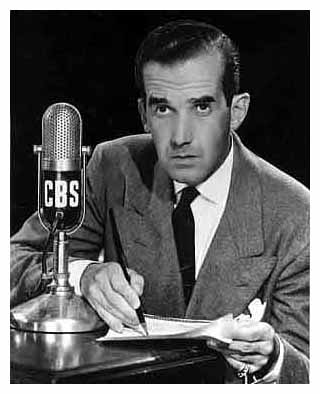
Edward R. Murrow

I got interested in Murrow after seeing him portrayed in the movie Good Night and Good Luck. Here are a few excerpts from the wiki on him:

Edward R. Murrow (born Egbert Roscoe Murrow 1908-1965) was an American broadcast journalist. He first came to prominence with a series of radio news broadcasts during World War II, which were followed by millions of listeners in the United States and Canada. Historians consider him among journalism's greatest figures, noting his honesty and integrity in delivering the news.
...
Murrow's report from the liberation of the Buchenwald concentration camp in Germany provides an example of his uncompromising style of journalism, something that caused a great deal of controversy and won him a number of critics and enemies. He described the exhausted physical state of the concentration camp prisoners who had survived, mentioned "rows of bodies stacked up like cordwood" and he refused to apologize for the harsh tone of his words:

“ I pray you to believe what I have said about Buchenwald. I have reported what I saw and heard, but only part of it. For most of it I have no words. If I've offended you by this rather mild account of Buchenwald, I'm not in the least sorry.
Here are a few other things that he said:

Everyone is a prisoner of his own experiences. No one can eliminate prejudices — just recognize them.

If we were to do the Second Coming of Christ in color for a full hour, there would be a considerable number of stations which would decline to carry it on the grounds that a Western or a quiz show would be more profitable.

A satellite has no conscience.

Except for those who think in terms of pious platitudes or dogma or narrow prejudice (and those thoughts we aren’t interested in), people don’t speak their beliefs easily, or publicly.

Anyone who isn't confused doesn't really understand the situation.

We are in the same tent as the clowns and the freaks — that's show business.

We hardly need to be reminded that we are living in an age of confusion — a lot of us have traded in our beliefs for bitterness and cynicism or for a heavy package of despair, or even a quivering portion of hysteria. Opinions can be picked up cheap in the market place while such commodities as courage and fortitude and faith are in alarmingly short supply.

Good night, and good luck. (Sign off line of his radio and TV broadcasts.)

Maya Angelou

According to the wiki, Maya Angelou (born Marguerite Ann Johnson in 1928) is an American poet, memoirist, actress and an important figure in the American Civil Rights Movement. She has been called "America's most visible black female autobiographer". Angelou is known for her series of six autobiographies, starting with I Know Why the Caged Bird Sings, (1969) which was nominated for a National Book Award. Her volume of poetry, Just Give Me a Cool Drink of Water 'Fore I Diiie (1971) was nominated for the Pulitzer Prize.

Angelou recited her poem, "On the Pulse of Morning" at President Bill Clinton's inauguration in 1993. She has been highly honored for her body of work, including being awarded over 30 honorary degrees. Here are a few things that she has said:

I've learned that people will forget what you said, people will forget what you did, but people will never forget how you made them feel.

At fifteen life had taught me undeniably that surrender, in its place, was as honorable as resistance, especially if one had no choice.

Nothing will work unless you do.

Courage is the most important of all the virtues, because without courage you can't practice any other virtue consistently. You can practice any virtue erratically, but nothing consistently without courage.

I have found that among its other benefits, giving liberates the soul of the giver.

If we lose love and self respect for each other, this is how we finally die.

H. G. Wells

One of my all-time favorite science fiction movies is the 1960 production of HG Wells' The Time Machine. Here is an excerpt from the wiki on Wells:

Herbert George Wells (1866-1946) was an English writer best remembered today for the science fiction novels he published between 1895 and 1901: The Time Machine, The Island of Doctor Moreau, The Invisible Man, The War of the Worlds, When the Sleeper Wakes, and The First Men in the Moon. Wells and Jules Verne are each sometimes referred to as "The Father of Science Fiction".

He was an outspoken socialist and a pacifist, his later works becoming increasingly political and didactic. His later novels were more realistic; they covered lower middle class life (The History of Mr Polly) and the 'New Woman' and the Suffragettes (Ann Veronica). He was a prolific writer of both fiction and non-fiction, and produced works in many genres, including contemporary novels, history, and social commentary. Here are a few of his more quotable sayings:

We must not allow the clock and the calendar to blind us to the fact that each moment of life is a miracle and mystery.

Affliction comes to us, not to make us sad but sober; not to make us sorry but wise.

Beauty is in the heart of the beholder.

Human history in essence is the history of ideas.

If we don't end war, war will end us.

If you fell down yesterday, stand up today.

It is not reasonable that those who gamble with men's lives should not pay with their own.

The doctrine of the Kingdom of Heaven, which was the main teaching of Jesus, is certainly one of the most revolutionary doctrines that ever stirred and changed human thought.

Paul Newman, 1925-2008

This just in from the Associated Press:

A spokeswoman for screen legend Paul Newman says the actor has died at age 83.

Spokeswoman Marni Tomljanovic says Newman died Friday of cancer. No other details were immediately available.

Newman was nominated for Academy Awards 10 times, winning a regular Oscar in 1987 for "The Color of Money" and two honorary ones. He was equally at home in comedies such as "The Sting" and dramas such as "Hud."

He sometimes teamed with his wife, Joanne Woodward, also an Oscar winner for the 1957 film "Three Faces of Eve."
I will always remember Paul as Fast Eddie Felson in that wonderful movie titled The Hustler. Other movie favorites of mine that featured his outstanding acting prowess have to include The Verdict, The Sting, Cool Hand Luke, and Butch Cassidy and The Sundance Kid.

What are your favorite Newman movies?